Drafting the blueprints for a sustainable oasis is exhilarating. Funding it? That’s where the nightmares usually begin. You have meticulously planned the geothermal heating, the reclaimed wood floors, and the passive solar alignment. Then, the financial reality hits hard.
Traditional lenders often balk at unconventional builds. They tend to see risk and unknown variables where you see long-term sustainability and energy independence. This specific financing gap routinely kills countless innovative projects before a single shovel hits the dirt.
But here is a closely guarded secret of the real estate development world. Highly specialized capital exists specifically for these ambitious, forward-thinking projects. We have navigated this financial labyrinth for years, and securing the right green construction loan completely changes the financial math of your build.
You do not have to compromise your environmental ethics just to appease a conservative bank underwriter. By leveraging specific programs designed for the US housing market, you can fund your net-zero ambitions while actually increasing your purchasing power. Let’s break down exactly how you can turn those blueprints into a funded reality at loanforphp.com.
The Anatomy of a Green Construction Loan
Understanding how these specialized financial products work is your first step toward approval. Standard mortgages simply evaluate your current debt-to-income ratio against the immediate appraised value of the home. A true green construction loan operates on an entirely different set of rules.
These specialized lenders actually factor your projected energy savings into your qualifying income. Because your monthly utility bills will be drastically lower, banks allow you to stretch your borrowing power further. This means that extra $40,000 for triple-pane windows suddenly becomes entirely justifiable on paper.
Appraising the Unconventional Build
I recently consulted on a breathtaking passive house project out in Colorado. The initial appraisal came in a devastating $50,000 under budget simply because the appraiser could not find local comparable sales with R-60 insulation and an airtight envelope. We had to immediately pivot to a lender who understood sustainable building loans.
We brought in an appraiser who held a Green Designation from the National Association of Realtors (NAR). They understood how to calculate the amortized value of the energy upgrades, instantly fixing our valuation problem. Always demand an appraiser who speaks the language of high-performance homes.
Navigating Eco-Friendly Home Financing Options
You have more options in the US market than you might realize. The federal government heavily incentivizes energy-efficient homebuilding through several well-established, though rarely advertised, mortgage avenues. Choosing the right one dictates your interest rate and down payment requirements.
Government-backed programs are often the easiest gateway for eco-friendly home financing. For example, the Federal Housing Administration (FHA) offers an Energy Efficient Mortgage (EEM) program. This allows borrowers to roll the cost of energy-saving improvements directly into their primary mortgage without needing a larger down payment.
Fannie Mae and VA Lending Secrets
Fannie Mae’s HomeStyle Energy mortgage is another phenomenal tool for American homebuilders. It grants borrowers up to 15% of the property’s “as-completed” appraised value specifically for energy improvements. This is massive for covering the premium costs associated with sustainable materials.
Veterans also have an incredible advantage here. The VA offers its own flavor of EEMs, capping the energy improvement costs at $6,000 without requiring a secondary appraisal. If you are mixing standard construction with deep green upgrades, stacking these benefits provides incredible financial leverage.
Cracking the Code on Solar Panel Financing
Adding a photovoltaic array is rarely just an accessory; it is a major capital expense. While third-party leases and Power Purchase Agreements (PPAs) are heavily marketed by door-to-door salesmen, they are rarely the smartest financial move. You want to own the system outright to capture the equity.
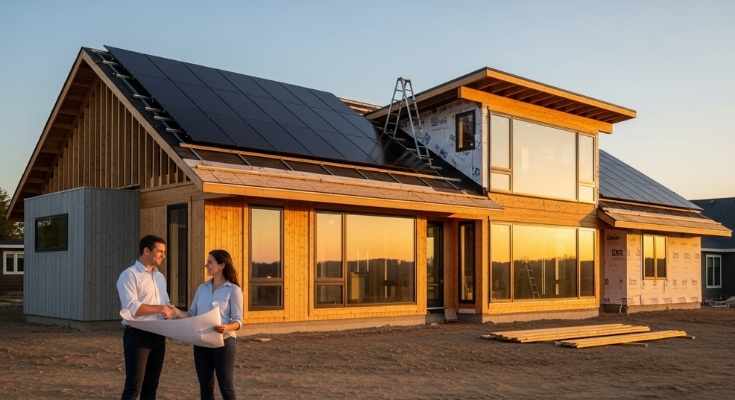
Wrapping your solar panel financing directly into your primary construction loan is almost always the most lucrative play. Lenders love solar when it is hard-coded into the initial architectural blueprint. It immediately bumps the appraised value of the finished property, padding the lender’s collateral.
Capturing the US Tax Credits
When you finance the panels yourself, you retain full rights to the federal Investment Tax Credit (ITC). Currently sitting at a massive 30% for US homeowners, this credit applies to both the equipment and the installation labor. A leased system forfeits that massive tax break entirely to the solar company.
Think of that 30% credit as an immediate rebate on your total construction costs. You can apply that massive tax return directly to the principal of your construction loan the following year. This strategy aggressively rapidly builds equity while slashing your long-term interest payments.
Proven Strategies for Sustainable Building Loan Approval
Bank underwriters are highly analytical and entirely risk-averse. You cannot simply walk into a branch talking passionately about your carbon footprint and expect a six-figure check. You must present a bulletproof, data-driven financial package.
Your secret weapon here is the Home Energy Rating System (HERS) Index. Lenders rely heavily on this standardized US metric to quantify exactly how efficient your home will be. Commissioning a certified RESNET rater to provide a projected HERS score based on your blueprints acts as undeniable proof of value.
Vetting Your Green Builder
The bank is not just evaluating you; they are heavily scrutinizing your general contractor. Traditional builders often underestimate the complexities of airtight envelopes or advanced framing techniques. This leads to blown budgets and delayed draw schedules, terrifying the lenders.
Only hire a contractor holding credentials like the LEED Green Associate or the NAHB Certified Green Professional designation. When we submit a loan package featuring a certified builder and a projected HERS score of zero, lenders fight for the contract. Preparation and professional documentation eliminate the bank’s perceived risk.
Funding the Future of Housing
Building an energy-independent sanctuary is one of the smartest investments you can make in today’s volatile energy market. The initial sticker shock of sustainable materials is entirely manageable when you unlock the right capital. You simply need to align yourself with financial institutions that understand the math behind the movement.
Stop letting outdated lending models crush your architectural vision. The capital is waiting, and the tax incentives have never been stronger for American homeowners. Take control of your home’s energy future today by exploring the specialized funding options available at loanforphp.com.
Frequently Asked Questions
Do I need a higher credit score for a green construction loan?
Not necessarily. While traditional construction loans usually require a score around 680 or higher, energy-efficient mortgages (EEMs) backed by the FHA can often be secured with scores as low as 580. The lender is heavily factoring in your future utility savings, which offsets some of the traditional credit risks.
Can I use these loans to retrofit an existing older home?
Absolutely. Programs like the Fannie Mae HomeStyle Energy mortgage are designed exactly for this purpose. You can purchase an older, inefficient property and finance up to 15% of the home’s final appraised value to install new insulation, HVAC systems, or solar arrays.
How does the appraisal work if there are no other green homes in my neighborhood?
This is a common hurdle. You must instruct your lender to hire an appraiser who has completed the valuation of sustainable properties training, such as the NAR Green Designation. They utilize an “income approach” or paired-sales analysis from a wider geographical radius to accurately value your home’s energy-saving features.
Is solar panel financing better through a bank or the solar installer?
Rolling the cost into your primary mortgage or construction loan is generally vastly superior. Installer financing often comes with hidden “dealer fees” that artificially inflate the principal by 15% to 25%. Bank financing allows you to keep your costs transparent while retaining the 30% federal tax credit.