Ever stared at an empty, muddy lot, wondering if that dream house will ever actually materialize? Traditional construction often feels like an endless, expensive waiting game. You break ground, and immediately the excuses start rolling in. Rain delays push the schedule back. Material shortages halt progress. Subcontractors simply ghost you. Meanwhile, your carrying costs are quietly eating through your life savings.
Modern modular building completely flips this frustrating script. Imagine bypassing the chaos of an open-air job site. We recently watched a massive, custom-designed property go from a freshly poured foundation to a weather-tight structure in less than 48 hours. Yes, you read that right. Two days.
This isn’t magic. It is the result of applying advanced manufacturing efficiency to the housing industry. Prefab houses aren’t those flimsy, temporary structures you might remember from decades ago. Today’s modular units are engineered marvels built with laser precision. They offer a legitimate, high-quality alternative to the unpredictable nature of stick-built construction. If you are exhausted by the thought of a year-long building nightmare, fast construction via modular methods is your absolute best escape hatch. Let’s dive into exactly how these homes go up so impossibly fast without sacrificing an ounce of quality.
The Blueprint of Modern Modular Building
Controlled Environments Change Everything
Imagine trying to build a complex, expensive piece of furniture in the middle of a rainstorm. That is essentially what traditional builders are forced to do every single day. Modular homes, however, are born entirely indoors. Massive, climate-controlled factories keep the lumber bone-dry and the workers perfectly comfortable year-round. This setup eliminates the dreaded weather delay entirely. You never have to worry about a sudden snowstorm halting your framing process for weeks on end.
Because the environment is strictly controlled, building materials simply do not warp or suffer water damage before the roof finally goes on. Quality control inspectors monitor every single nail, joint, and wire on the assembly line. You simply cannot replicate this level of rigorous, standardized precision out in the open elements.
The Simultaneous Site Prep Advantage
Here is where the timeline really gets slashed. While your walls, floors, and roof are taking shape inside the factory, your local crew is simultaneously prepping the land. The concrete foundation gets poured and cured at the exact same time your framing is completed fifty miles away. This overlapping schedule cuts the overall construction timeline by up to fifty percent compared to site-built homes.
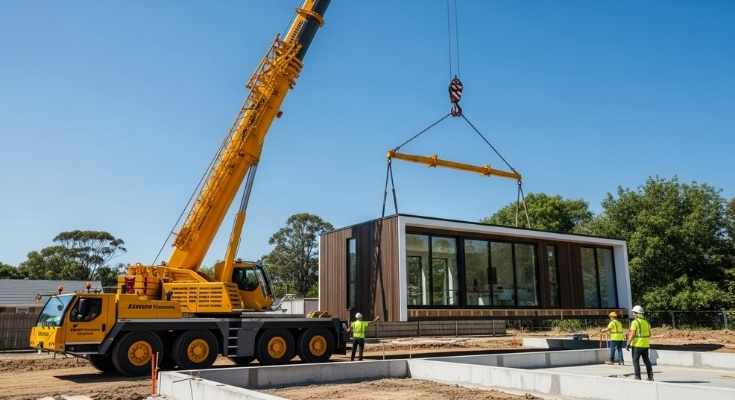
Once the finished modules arrive on-site, a massive crane drops them onto the waiting foundation like giant, highly-engineered Lego blocks. The button-up process—connecting the individual modules, finishing the drywall seams, and hooking up the municipal utilities—takes mere weeks, not agonizing months.
Prefab Houses vs. Stick-Built: What the Experts Know
Stronger by Design
Here is an industry secret most traditional contractors will never share with you. Manufactured homes and modular builds often possess a significantly sturdier structural framework than their site-built cousins. Why? Because they physically have to survive a turbulent highway journey at sixty miles per hour.
Factories utilize extra lumber, specialized industrial adhesives, and heavy-duty lag bolts to ensure the modules withstand transport stresses without cracking. When these heavily reinforced sections are finally bolted together on your permanent foundation, the resulting structure is incredibly rigid. Many veteran structural engineers note that modular homes frequently outperform traditional builds during extreme weather events, including hurricanes and massive snow loads.
Energy Efficiency Out of the Box
Precision cutting tools used in the factory ensure tighter structural joints and vastly reduced air infiltration. Modern modular building prioritizes superior insulation techniques from day one, aggressively driving down your future utility bills. The air-sealing process is meticulous, often utilizing advanced spray foams that seal every conceivable gap.
We consistently hear prefab owners bragging about their astonishingly low heating and cooling costs during peak seasons. Because the home is built from the inside out, insulation can be placed in areas that are nearly impossible to reach on a traditional site. Your home essentially functions like a giant, well-insulated thermos, keeping your family perfectly comfortable regardless of the outside temperature.
Financing Your Fast Construction at LoanForPHP
Navigating Construction-to-Permanent Loans
Securing funding for hyper-fast construction projects requires a slightly different approach than buying an existing, move-in-ready house. You typically need a construction-to-permanent loan. The bank releases funds in specific stages, known as “draws,” as the factory finishes the modules and the on-site crew completes the foundation.
Because the modular timeline is incredibly compressed, your lender needs to be agile and responsive. At loanforphp.com, we deeply understand the rapid pace of the modern modular industry in the USA. You absolutely cannot afford to have a finished module sitting idle in a factory lot because your bank is dragging its feet on releasing the next payment draw. We specialize in matching buyers with lenders who understand the speed of prefab builds.
Appraisals and Long-Term Value
Let’s crush an old, persistent myth right now. Permanent modular homes appraise exactly the same as traditional site-built homes. Banks, appraisers, and the local tax assessor treat them identically once they are permanently affixed to a foundation.
They build equity just as quickly as the house next door. You can eventually refinance or sell the property using standard real estate protocols without any hidden penalties. Fast construction does not mean compromising on your long-term financial investment. In fact, by saving on carrying costs during a shorter build, you actually start your homeownership journey in a vastly stronger financial position.
Real-Life Speed: A Hypothetical Case Study
The Initial Order and Factory Build
Let’s look at a highly realistic scenario based on current USA industry capabilities. The Smith family finalized their custom floor plan and secured their loan on March 1st. By March 15th, the factory began framing the heavy-duty floor joists.
Working on a hyper-efficient assembly line, the drywall, electrical wiring, and rough plumbing were installed simultaneously by specialized teams. Kitchen cabinets were hung, and premium flooring was laid down before the walls ever saw the sun. The entire four-module home was completely finished, inspected, and shrink-wrapped for safe transport by April 10th.
The Crane Day Magic
The local site crew finished pouring and curing the basement foundation on April 12th. Two days later, a massive industrial crane arrived at the property. Over a single, highly orchestrated morning, the shrink-wrapped modules were lifted from flatbed trucks and locked perfectly into place.
By lunchtime, the Smiths were walking through their new living room, marveling at the fully installed windows and painted walls. The remaining local timeline involved siding the exterior marriage lines, connecting the main plumbing stack, and building the front porch. They turned the key and moved their furniture in exactly sixty days after signing the final design documents.
Your Fast Track to Homeownership
Stop waiting years to finally live in the home you deserve. The sheer stress of managing unpredictable contractors and suffering through endless delays is completely optional. Modular homes deliver superior build quality, incredible energy efficiency, and a timeline that actually respects your life and your wallet.
The construction revolution is already here, happening inside state-of-the-art factories right now. Are you ready to bypass the massive headaches of traditional building and step into a modern, precision-engineered house?
Visit loanforphp.com today to explore customized, high-speed financing options perfectly tailored for your rapid modular build. Let’s get your foundation poured and get you home faster.
Frequently Asked Questions
Q: Do modular homes lose value over time?
A: Absolutely not. Once a modular home is permanently attached to a foundation, real estate markets treat it exactly like a site-built home. They appreciate in value at the exact same rate as traditional homes in your local neighborhood.
Q: Can I customize a prefab house?
A: Yes. Modern modular building offers near-limitless customization. You can choose specific floor plans, high-end cabinet finishes, premium siding, and custom roofing options. If you can dream it, the factory can likely build it.
Q: Is fast construction really safe?
A: It is incredibly safe. The speed comes from manufacturing efficiency and simultaneous site work, not from cutting corners. Every home is built to meet or exceed strict state and local building codes, passing multiple factory inspections before it ever leaves the facility.
Q: Are manufactured homes and modular homes the same thing?
A: No. Manufactured homes (historically called mobile homes) are built to a national HUD code and usually remain on a steel chassis. Modular homes are built to local state building codes—just like a traditional home—and are permanently placed on a concrete foundation.