Staring at a vacant patch of dirt, envisioning your perfect kitchen, only to be hit with a wall of bank bureaucracy? That stings. We know exactly how frustrating it feels to have the blueprints ready while the financing drags on for months.
Securing a home construction loan doesn’t have to be a multi-month, agonizing ordeal. Most future homeowners shoot themselves in the foot by treating this process like a traditional mortgage application. It is an entirely different beast requiring a vastly different strategy.
When you buy an existing house, the bank has immediate collateral. When you build from scratch, lenders are effectively sinking money into a phantom asset that doesn’t exist yet. This inherent risk makes underwriters incredibly nervous, leading to microscopic scrutiny of your finances.
To achieve fast housing loan approval, you must anticipate their anxieties and neutralize them before they even ask. We have seen well-prepared buyers get the green light in a matter of weeks by front-loading their documentation. It all comes down to controlling the narrative and presenting a bulletproof project plan.
Whether you are breaking ground in the American Midwest or navigating international financing like a home loan PHP for a retirement villa abroad, the core principles remain fiercely rigid. Let’s dive into the exact blueprint you need to bypass the red tape and get those excavators moving.
Decoding the Complexities of Building a House Finance
Understanding how a bank views your project is the first step toward rapid approval. Unlike a standard mortgage where you get a lump sum at closing, building a house finance operates on a strict “draw schedule.” The bank releases funds in staggered increments only after specific construction milestones are met and verified by an appraiser.
This means your lender is not just evaluating your wallet; they are evaluating the feasibility of the entire project. If your timeline looks sloppy or your budget lacks a contingency cushion, the underwriter will hit the brakes. We always advise clients to factor in a minimum 10% to 15% contingency reserve into their total requested loan amount.
Lenders love predictability. When you present a budget that already accounts for skyrocketing lumber prices or unexpected foundation issues, you signal financial maturity. We once watched a client breeze through underwriting simply because they provided a hyper-detailed, line-item budget that included expected inflation costs for materials.
Furthermore, you need to understand the difference between a construction-to-permanent loan and a standalone construction loan. The former automatically rolls into a standard mortgage once the house is built, saving you a second set of closing costs. Opting for the “single-close” route often streamlines the initial approval process because the long-term financing is already baked into the deal.
Ironclad Documentation: Your Blueprint for Fast Housing Loan Approval
If you want to shave weeks off your wait time, you need to create what industry insiders call a “Lender’s Bible.” Handing a loan officer a disorganized folder of loose W-2s and vague architectural sketches is a guaranteed way to land at the bottom of the review pile. You need to overwhelm them with absolute clarity and meticulous organization.
Start with the absolute non-negotiables: two years of pristine tax returns, recent pay stubs, and an immaculate credit report. However, for a home construction loan, your debt-to-income (DTI) ratio needs to be exceptionally lean. While conventional mortgages might allow a DTI up to 45%, construction lenders typically want to see that number hovering under 36% due to the added risk of budget overruns.
Next, focus on your equity injection. Banks rarely finance 100% of a custom build; they usually cap out at 80% of the projected appraised value. You need to prove you have the remaining 20% in liquid, accessible cash, fully documented and sitting in an account for at least two months to satisfy sourcing rules.
Consider the hypothetical case of a buyer who documented every single penny of their down payment origin, alongside a comprehensive timeline mapped out in a clean spreadsheet. Their loan officer didn’t have to hunt for information or ask follow-up questions. By doing the underwriter’s job for them, you drastically accelerate the timeline toward that coveted fast housing loan approval.
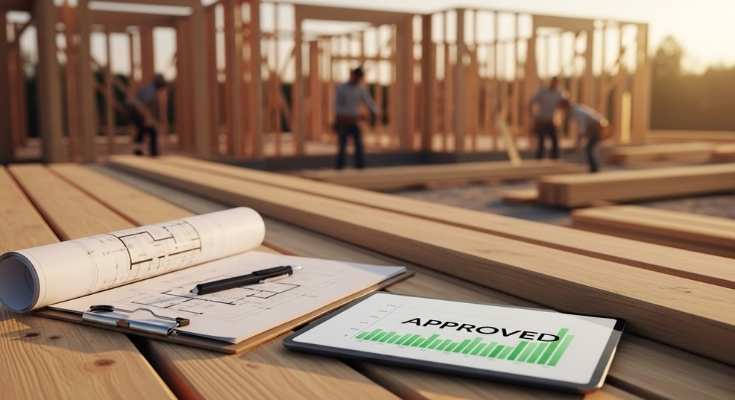
Vetting the Right Builder to Satisfy Jittery Underwriters
Here is a secret most buyers completely miss: your lender is scrutinizing your general contractor just as harshly as they are scrutinizing you. You could have an 800 credit score and millions in the bank, but if your chosen builder is unproven or financially unstable, your loan will be denied. Banks need absolute confidence that the person pouring the concrete actually knows how to finish the job on budget.
Do not walk into a bank with a buddy who “does a little carpentry on the side.” You need a licensed, heavily insured, and highly experienced general contractor with a verifiable track record of completing custom homes. The bank will demand your builder’s resume, their business credit report, proof of liability insurance, and references from local suppliers.
To speed things up, have your builder prepare a professional portfolio before you even apply. This package should include a finalized, signed construction contract complete with exact specifications, a rigid draw schedule, and a realistic completion date. When a lender sees a heavily detailed contract from a reputable firm, their risk algorithms relax significantly.
We often recommend that buyers ask their potential builders about their existing relationships with local banks. A contractor who regularly works with a specific local lender already has their credentials on file. Leveraging that pre-existing trust can entirely bypass the builder-approval phase, rocketing your application to the front of the line.
Strategic Lender Selection and Unconventional Avenues
Not all banks are created equal when it comes to funding custom builds. Walking into a massive, national mega-bank for a bespoke construction project often leads to algorithmic rejections and confused tellers. Large institutions thrive on cookie-cutter loans; they despise the messy, localized nuances of custom home construction.
Your best bet for speed and flexibility almost always lies with local community banks and regional credit unions. These institutions understand the local real estate market, know the local builders, and keep their underwriting decisions in-house. Because the loan officer can literally walk down the hall to speak directly with the underwriter, bottlenecks are resolved in minutes rather than weeks.
Sometimes, geographic and financial borders get creative. For instance, US-based investors looking to fund builds overseas often explore localized financial instruments, utilizing a home loan PHP or equivalent regional financing to construct properties in the Philippines. While the currency and jurisdiction change, the demand for impeccable credit, builder vetting, and aggressive risk management remains exactly the same.
If you are facing roadblocks, consider utilizing a specialized mortgage broker who deals exclusively in construction lending. These brokers know exactly which local banks are currently hungry for construction debt and which ones are tightening their belts. Paying a slight premium for a broker’s rolodex can save you months of fruitless applications and protect your credit score from unnecessary hard inquiries.
Securing Your Financial Foundation
Stop letting financing delays dictate your life’s timeline. The blueprint for swift approval isn’t shrouded in mystery; it is simply a matter of radical preparation and understanding the bank’s deep-seated fears. By treating your application like a professional business proposal, you eliminate the guesswork for the underwriter.
Gather your financial documents with obsessive precision, partner with a builder whose reputation is bulletproof, and target local lenders who actually understand your market. Every day you spend organizing your “Lender’s Bible” is a week saved in the underwriting department.
It is time to take absolute control of your building journey. Stop waiting for the bank to ask for information and start proactively overwhelming them with proof of your project’s viability. If you are ready to secure the best rates and move your project from paper to pavement, explore our comprehensive lending resources at loanforphp.com today.
Frequently Asked Questions (FAQ)
What is the minimum credit score required for a home construction loan?
Most lenders demand a significantly higher credit profile for construction than for traditional mortgages. You should aim for a minimum FICO score of 680, though a score of 720 or higher is highly recommended to secure fast approval and favorable interest rates.
Do I have to pay interest on the full loan amount during construction?
No, you only pay interest on the funds that have actually been drawn and paid out to your builder. If your total loan is $500,000 but only $100,000 has been used for the foundation and framing, your monthly payment is calculated solely on that $100,000.
Can I act as my own general contractor to save money?
While “owner-builder” loans exist, they are notoriously difficult to get approved and almost never qualify for “fast” processing. Unless you are a licensed contractor by trade, lenders view owner-builders as a massive liability and will likely reject the application.
How does a home loan PHP factor into US-based financing?
A home loan PHP generally refers to financing secured in Philippine Pesos, often utilized by expats or dual citizens building property in the Philippines. U.S. banks typically do not lend across international borders, so borrowers must either use domestic equity (like a HELOC on a US property) or work directly with international or Philippine-based lenders.